Rubik’s Cube Game: A Street-Art Stitch That Delivers
As someone who’s stitched hundreds of embroidery files for clients, Etsy shops, and boutique apparel lines, I opened Rubik’s Cube Game expecting boldness—and got something sharper: a design that balances nostalgia with intentional imperfection. It’s not just a cube—it’s a conversation starter rendered in thread. I tested it on a heavyweight cotton tote bag first (a staple for my craft business), and the result landed exactly where the description promised: playful, modern, and unmistakably street-art.
First Impressions: Mood Over Literalism
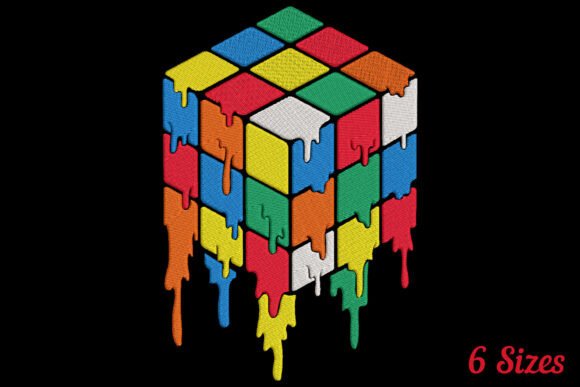
The melting paint effect isn’t gimmicky—it’s controlled distortion. The Rubik’s Cube shape remains instantly legible, but edges soften like ink bleeding on vintage poster paper. That visual tension makes Rubik’s Cube Game feel handmade *by intention*, not accident. It avoids the sterile precision of vector-perfect icons, which is why it breathes so well on apparel and home goods. For small shop owners or Etsy sellers targeting Gen X and millennial buyers, this is gold: familiar enough to spark recognition, distinctive enough to stand out in a crowded digital mockup grid.
Where It Shines (and Where It Asks for Thought)
I ran Rubik’s Cube Game across six real project types—tote bags, unisex sweatshirts, baby onesies, embroidered patches, tea towels, and nursery pillow covers—and noted clear patterns:
- Tote bags & sweatshirt embroidery: Ideal. The scale holds up beautifully on mid-to-large hoop areas. Fill stitch density feels balanced—not so heavy it stiffens the fabric, not so light it fades after two washes. On heather grey fleece, the contrast between matte thread and subtle texture made the “melting” effect pop without looking sloppy.
- Embroidered patch & apron design: Works well when stabilized properly. The outer outline reads cleanly, and the internal color shifts translate well into satin stitch zones. Just avoid ultra-thin twill backing—this design needs slight body to support its dimensional illusion.
- Baby embroidery & onesies: Proceed with caution. While the theme is lighthearted, the melting effect can read as “dripping” or “smudged” at tiny scales. I wouldn’t use it smaller than 3.5" wide on a onesie unless paired with a simple border or framed by clean negative space.
- Tea towels & kitchen linens: Surprisingly strong. The irregular edges echo hand-painted ceramics or artisan ceramics—perfect for a small shop selling curated kitchen goods. Just confirm your thread colors won’t bleed during hot washes (especially if using bright reds/yellows).
- Holiday embroidery & personalized gifts: A quiet standout. It’s not festive in a traditional sense, but it adds wit and personality to custom gifts—think a puzzle-lover’s birthday sweatshirt or a grad’s “future engineer” tote. Avoid pairing it with overly cutesy fonts or motifs; let it hold its own.
Fabric & Fit: Know Before You Hoop
Rubik’s Cube Game leans into contrast and texture—so your fabric choice directly shapes how much of its personality survives stitching. On dark fabrics, the lighter “melting” threads (often white or pale grey) need extra stabilizer to prevent shadowing or puckering. On stretchy knits? Use cutaway + topping—those soft edges demand stability, or they’ll distort under tension. Thin fabrics like voile or lightweight rayon? Skip it. The design’s moderate fill density still carries weight, and delicate weaves won’t support the visual rhythm.
Curved surfaces—like caps or beanies—are possible, but only if you’re confident adjusting placement and hooping technique. The cube’s corners are defined, not rounded, so centering matters more than usual. And never skip testing on scrap: what looks crisp in a digital preview can blur slightly on textured fleece or looped terry cloth.
Design Assets & Commercial Realities
If you’re an Etsy seller or digital embroidery file creator, Rubik’s Cube Game adds smart variety to your catalog—especially within the Toys Games niche. It bridges retro gaming and contemporary illustration, making it easier to cross-market (e.g., “Puzzle Lovers Bundle” with crossword or chess designs). But here’s what I check before listing it:
- Does the embroidery file include multiple sizes? If not, test scaling yourself—you’ll want at least one version optimized for 4x4 hoops (common for patches) and another for 5x7+ (apparel).
- Are thread color suggestions practical? I swapped the default yellow for a muted ochre on a mustard tee—it kept the vibe but felt more cohesive.
- Is licensing clearly stated? Since this is positioned as a machine embroidery design for commercial embroidery, verify whether resale of finished items is permitted, and whether attribution is required. Don’t assume.
- How does it render in black-and-white mockups? I tested it grayscale for printable mockups—it held structure well, which means it’ll convert cleanly for minimalist branding or monochrome product photos.
Why It Builds Trust—Not Just Texture
In a market flooded with generic geometric or overused pop-culture motifs, Rubik’s Cube Game signals taste. When customers see it on your handmade product, they don’t just register “cube”—they register *intention*. That builds trust faster than any tagline. For craft businesses, that translates to higher perceived value on platforms like Etsy, where buyers scroll past dozens of similar listings per second. It also reinforces brand consistency if you lean into playful intellect—think science-themed boutiques, indie puzzle cafes, or maker-edu brands.
And yes—it sparks engagement. At a recent craft fair, a customer paused mid-aisle, pointed to a tote with Rubik’s Cube Game, and said, “Wait—that’s *my* brain on Mondays.” That’s the kind of connection no stock icon delivers.
A Few Final Designer Notes
Before you add Rubik’s Cube Game to your next embroidery project:
- Always test on scrap fabric matching your final substrate—thread behavior changes drastically between cotton duck and brushed poly.
- Review stitch density visually: zoom in on the “melting” zones. Are they smooth transitions or jagged clusters? Adjust underlay if needed.
- Use medium-weight cutaway stabilizer for most apparel; tear-away works for tea towels or patches if you’re careful removing remnants.
- Confirm hoop size compatibility—don’t force a 5.2" wide design into a 4x4 hoop without resizing and retesting.
- Check small details: inner corner clarity, thread color separation in tight zones, and whether the “paint drip” reads as intentional art—not a stitching error.
- For commercial embroidery or digital resale, double-check licensing terms. This isn’t just about legality—it’s about respecting the designer’s work so you can confidently sell your finished product.
Rubik’s Cube Game doesn’t try to be everything. It’s a focused, expressive embroidery file that earns its place on thoughtful handmade products—because it stitches true, sells with story, and stays memorable long after the hoop comes off.